Stainless steel parts in Automotive Industrials
In the high-performance world of 2026 automotive manufacturing, Stainless Steel Investment Casting (also known as precision casting) has become a cornerstone technology for both traditional Internal Combustion Engine (ICE) vehicles and the rapidly growing Electric Vehicle (EV) sector.
The Invisible Strength: Stainless Steel Precision Casting in Modern Autos
When we think of car manufacturing, we often imagine giant presses stamping out body panels. But beneath the surface, the most critical, high-stress components are increasingly born from Stainless Steel Investment Casting. As of 2026, the automotive segment dominates the investment casting market with a 29% revenue share, driven by a desperate need for parts that are both lighter and more durable.
1. Why Stainless Steel? The Trifecta of Performance
Precision casting allows engineers to use high-grade stainless steel alloys to solve three major engineering headaches:
Extreme Heat Tolerance: With exhaust systems reaching temperatures of 1,000°F to 1,200°F, stainless steel's ability to maintain structural integrity without warping is unmatched.
Corrosion Resistance: Unlike carbon steel, stainless steel creates a built-in chromium oxide layer that protects against road salt, moisture, and chemicals.
High Strength-to-Weight Ratio: It allows for "thin-walled" designs—some as thin as 0.5mm—that are incredibly strong yet help reduce the overall vehicle weight to boost fuel and battery efficiency.
2. Widespread Applications: From ICE to EV
The shift to electrification hasn't killed the casting industry; it has redefined it.
Exhaust & Turbo Systems: Stainless steel comprises 45% to 50% of all modern exhaust systems, including manifolds and catalytic converter housings.
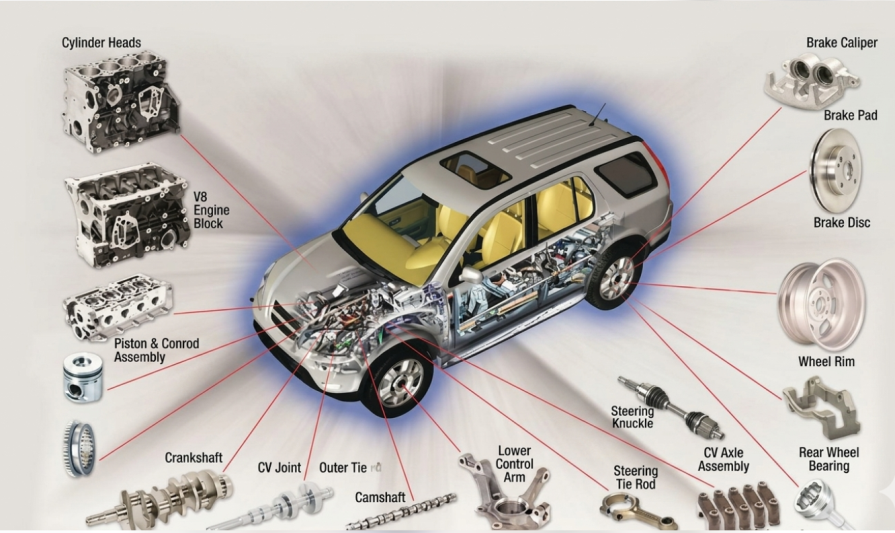
Electric Vehicle (EV) Innovations: In 2026, EVs rely on precision cast stainless steel for battery cooling system connectors, high-pressure sensors, and motor housings that require "net-shape" accuracy to prevent leaks.
Safety & Structural: Critical components like door hinges, fuel tanks, and even decorative trim benefit from the superior surface finish and "micron-level" accuracy of the investment process.
3. The "Net-Shape" Advantage: Saving Time and Money
One of the biggest reasons manufacturers like GM and BMW utilize this process is the reduction in "post-processing."
Precision: Investment casting achieves CT4–6 precision, which is significantly higher than sand casting.
Cost Savings: Because the parts are cast so accurately, the need for further machining is practically non-existent. This saves millions in labor and material waste across a high-volume production line.
Conclusion: The Future is Cast in Steel
As the global investment casting market heads toward a projected $30.56 billion by 2034, stainless steel remains the "gold standard" for parts that cannot afford to fail. Whether it's a turbocharger in a high-performance hybrid or a cooling manifold in a long-range EV, precision casting is the silent force keeping the 2026 automotive industry moving forward.