
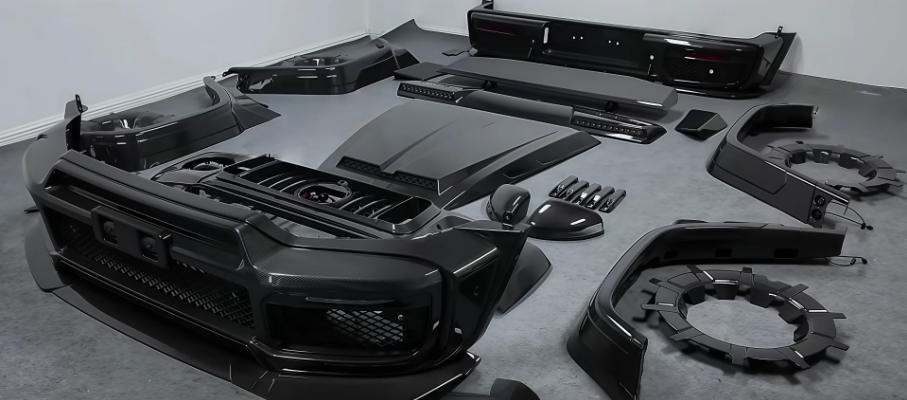
Carbon Fiber Vehicle Outer Panel
Custom carbon fiber parts manufacturing involves creating lightweight, high-strength components through a specialized process: CAD design, mold fabrication (often CNC-machined), curing (prepreg or infusion), and finishing. It offers tailored structural properties for automotive, aerospace, and hobbyist projects. Common techniques include vacuum bagging, resin infusion, and autoclave curing for maximum quality.
Key Manufacturing Processes
Design & Tooling: Engineers create CAD models to design the part, followed by creating a master plug and mold, often using CNC machining to ensure precise, repeatable shapes.
Layup (Dry/Wet): Carbon fiber fabric is cut and placed into the mold, with layers alternated to manage structural stress.
Resin Infusion & Curing: Resin is introduced into dry fibers under vacuum, or pre-impregnated (prepreg) sheets are used, then cured at high temperatures to form a rigid structure.
Finishing & Inspection: Parts are trimmed, sanded, and coated for UV protection, followed by inspection for structural integrity and dimensional accuracy.
Common Techniques
Autoclave: Produces the highest strength parts by applying high pressure and heat.
Vacuum Infusion: A cleaner process providing excellent fiber-to-resin ratios and superior cosmetic quality.
Forged Composite: Uses chopped carbon fibers, allowing for complex, thick, and three-dimensional designs.
Custom parts ensure superior performance through optimized fiber orientation and weight savings compared to mass-produced alternatives.